


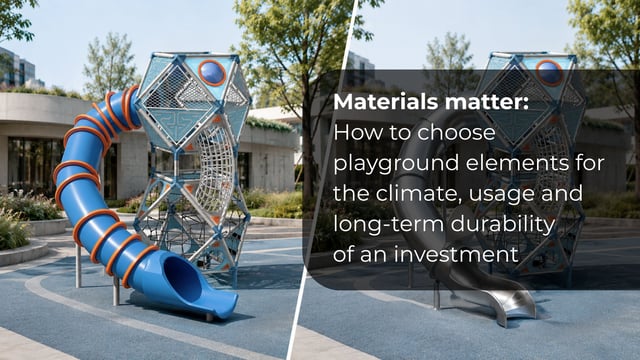
Materials matter: How to choose playground elements for the climate, usage and long-term durability of an investment
Materials matter: how to choose playground elements for the climate, usage and long-term durability of an investment
The difference may seem small in a visualisation. In everyday use, however, the choice of material affects children's comfort, equipment durability, the appearance of the space and the long-term maintenance costs of the playground.
Playground design usually begins with function, layout, user groups and the attractiveness of the equipment. Safety zones, accessibility and technical requirements are then analysed. Materials often appear only at the specification stage. However, they should be treated as an important design decision from the very beginning.
The material determines how the equipment will perform during hot weather, rain, frost and long-term exposure to UV radiation. It affects surface temperature, user comfort, resistance to damage, maintenance requirements and the appearance of the playground after several years of use.
At Inter Play, we believe there is no single material that is best for every project. That is why selected collections are available in different material versions, allowing architects and investors to adapt the equipment to the specific conditions of each location.
Choose the material for the location, not only for the product
Two playground units may have almost the same shape, functions and colour scheme, while differing only in the material used for one element. At the concept stage, this change may appear purely visual. In practice, however, it can influence user comfort, durability and future maintenance costs.
Material selection should therefore begin with an analysis of the location. Different solutions will be suitable for a shaded playground in a moderate climate, an open site in Southern Europe or a coastal location where equipment is exposed to moisture and salty air.
The type of investment is also important. A small residential playground will be used differently from a central recreational area in a public park, next to a school or at a popular tourist destination. Materials should respond not only to weather conditions, but also to the expected level of use.
User comfort begins with the surface
Children come into direct contact with many parts of playground equipment. They hold handrails and grips, sit on seats, climb on panels, move through tunnels and use slides.
For these elements, resistance to damage is not the only important factor. Surface temperature, texture and the way the material absorbs and releases heat also affect the experience of play.
Particular attention should be paid to surfaces that remain in contact with the body for longer periods. A slide is a good example. During the ride, a child touches the surface with their hands, legs and often a large part of their body. The material and its temperature therefore have a direct impact on comfort.
Surface temperature does not depend only on the type of material. Colour, exposure to sunlight, time of day, air temperature and the presence of natural or designed shade are also important.
The local microclimate matters as much as the regional climate
Knowing that a project is located in Poland, Spain or the Middle East is important, but it is not enough to make the right decision. Two playgrounds in the same city may operate under completely different conditions. One may be shaded by tall buildings, while another may be exposed to direct sunlight from morning until evening.
During the design process, it is worth analysing the orientation of the equipment, existing and planned greenery, nearby buildings, pergolas, canopies and the hours of strongest sunlight.
Sometimes the best solution is not to change the whole unit, but to adjust the position of the slide, use the shade created by a building or introduce planting that will improve comfort in the future.
Stainless-steel slide or plastic slide?
A slide is a good example of why the material should be selected according to the project conditions, rather than only according to habit or appearance.
Stainless-steel slides are valued for their high durability, resistance to intensive use and modern architectural appearance. They work particularly well in minimalist public spaces and combine naturally with architectural concrete, glass, steel and stone. Their smooth surface is easy to clean, and a properly designed and manufactured slide can maintain its functional and visual qualities for many years. In strongly exposed locations, however, the position of the equipment and the availability of shade require careful consideration.
Rotomoulded plastic slides provide greater freedom in terms of form and colour. They can be matched to the colour palette of the entire collection, the theme of the playground or the visual identity of the development. They are often selected for projects where strong colours and softer, more playful forms are important.
In the Inter Play SFERO collection, we offer a choice between a stainless-steel slide and a plastic version. This means that the architect does not need to adapt the entire concept to one fixed solution. Instead, the most suitable option can be selected according to the climate, sunlight exposure, expected appearance and way the playground will be used.
The key question is not: Which slide is better?
It is: Which slide is better for this location and this particular project?
The level of use changes the priorities
A small playground next to a residential building may mainly be used by the same group of children. A large recreational area in a city centre may receive hundreds of users every day.
In heavily used locations, resistance to wear and mechanical damage becomes especially important. Easy inspection, access to spare parts and the possibility of replacing individual components should also be considered.
In public projects, the future maintenance model matters as well. A solution that requires regular care may work well on a private site with dedicated technical support, but may be less practical in a large public park managed together with many other facilities. The material should therefore be matched not only to the expected number of users, but also to the future management and maintenance of the playground.
Durability should be considered throughout the whole life cycle
The purchase price is only one part of the real cost of a playground. Over time, additional expenses may include inspections, cleaning, maintenance, replacement of components and repairs caused by intensive use or weather conditions.
A material with a lower initial price is not always the more economical solution. If it requires more frequent maintenance, loses its appearance more quickly or is harder to repair, its overall lifetime cost may be higher.
When comparing material options, it is worth considering their expected durability, maintenance frequency, the possibility of replacing individual parts and the appearance of the equipment after several years of use. For investors, this approach helps use the budget more effectively. For architects, it makes it possible to create a space that maintains its quality long after the opening day.
Regulations and investor requirements
Material selection is not always decided by the designer alone. Many markets have additional national requirements, local authority guidelines or internal investor standards.
In addition to compliance with the relevant EN 1176 requirements, it is important to review tender documentation, anti-corrosion requirements, surface-finishing specifications, warranty conditions and expected service life.
Checking these issues early in the design process reduces the risk of costly changes during implementation. The possibility of selecting different material versions then becomes a practical design tool rather than simply an additional product option.
Materials also shape the character of the space
Materials influence how a playground fits into its surroundings. Stainless steel supports a modern, precise and architectural appearance. Coloured plastics make it possible to create more expressive compositions, develop thematic concepts and match the equipment to the colours of a preschool, school, residential development or public park.
This does not mean that one material has greater design value than another. The final result depends on the quality of execution, the consistency of the concept and the relationship between the equipment, architecture, greenery and surfacing.
Questions to ask before selecting materials
Before finalising the specification, it is worth considering:
- What climate and local microclimate will the playground operate in?
- How long will the equipment be exposed to direct sunlight?
- Which surfaces will remain in contact with the child?s body for the longest time?
- How intensively will the playground be used?
- Who will be responsible for maintenance?
- What requirements are included in local regulations and investor documentation?
- What architectural effect should the project achieve?
The answers help select materials that respond not only to the visual concept, but also to the real operating conditions of the playground.